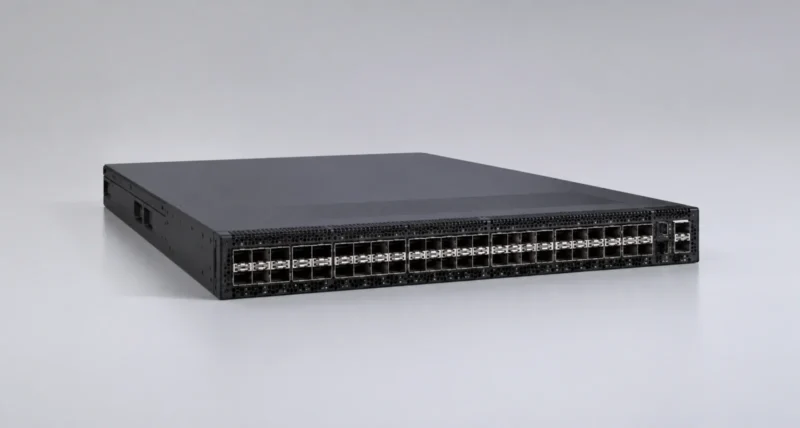
Marvell just announced what might be the most important AI hardware story you have never heard of. The Teralynx T100, unveiled on June 1, 2026, is a single piece of silicon that can move 102.4 trillion bits of data every second. It is not a GPU, not a CPU. It is a network switch chip, the kind of part that lives inside data centres and quietly decides how fast every AI model in the world can train.
Why is it news? Because as AI clusters scale to tens of thousands of GPUs, the chips talking to each other becomes the bottleneck, not the chips themselves. Marvell’s pitch with the T100: lower power than rivals, lower latency, and an architecture built specifically for AI traffic patterns. The Teralynx T100 starts sampling to customers this quarter.
Here is the short version. Teralynx T100 is a 102.4 Tbps switch silicon built on 3nm, uses under 1000W of power (25 percent less than competitive solutions per Marvell), supports a 512-port scale-out radix, and is purpose-built for AI clusters. Marvell’s direct competitor is Broadcom’s Tomahawk 6, which already ships at the same 102.4 Tbps tier. Below is everything else worth knowing.
1. What Is the Marvell Teralynx T100?
Teralynx T100 is a switch silicon, a chip that sits at the heart of network switches in cloud and AI data centres. Its job is to take traffic coming in on hundreds of fibre or copper links and forward it to the right destination at line speed. The T100 does this at 102.4 terabits per second of total throughput, twice the bandwidth of the previous generation Teralynx parts.
The official Marvell announcement frames it as the industry’s first 102.4 Tbps switch silicon purpose-built for AI. The purpose-built phrasing matters, because Broadcom’s Tomahawk 6 series already ships at the same 102.4 Tbps tier and has been in production for months. Marvell’s argument is that the T100 was architected from the ground up for AI traffic, while competitors retrofitted older switch designs.
The product builds on Marvell’s existing Teralynx family, which ranges from 12.8 Tbps to now 102.4 Tbps. The previous-generation Teralynx 10 (at 51.2 Tbps) is already in volume production across AI cloud deployments.
2. Teralynx T100 Specs at a Glance
The headline numbers from Marvell’s announcement on a single page.
| Spec | Detail |
| Total bandwidth | 102.4 Tbps (102.4 trillion bits per second) |
| Process node | Advanced 3nm process technology |
| Architecture | Monolithic single die (no chiplets) |
| Typical power | Under 1,000 watts |
| Power advantage | Up to 25 percent lower than competitive solutions (per Marvell) |
| Scale-out port radix | Up to 512 ports |
| Supported protocols | Ethernet, Ultra Ethernet Consortium (UEC), Ethernet Scale-Up Networking (ESUN) |
| Packaging options | BGA, Co-Packaged Copper (CPC), Co-Packaged Optics (CPO) |
| Software stack | Marvell SDK, OCP Switch Abstraction Interface (SAI), SONiC OS |
| Availability | Sampling to customers Q2 2026 |
| Direct competitor | Broadcom Tomahawk 6 (also 102.4 Tbps, already shipping) |
3. The Problem: AI Networks Are Becoming the Bottleneck
To understand why anyone should care about a 102.4 Tbps switch, you need to understand how large AI models are trained. A single AI training run for a frontier model (anything in the GPT-5.5, Claude Opus 4.8, or Gemini 3.5 league) involves thousands to tens of thousands of GPUs working in parallel. Each GPU needs to constantly share gradients and model state with every other GPU.
Here is the catch: a GPU sitting idle while it waits for data from another GPU is a GPU you are still paying for. At a cost of $30,000 to $40,000 per high-end accelerator, idle GPUs are the most expensive empty seats in computing. Network inefficiencies in an AI cluster translate directly to underutilised GPUs and higher training costs.
Marvell quotes the analyst firm 650 Group estimating that switching and networking now consume roughly 15 to 25 percent of total rack power in modern AI data centres. The same announcement notes that GPU and XPU racks are approaching 120 kilowatts each, pushing facilities to the limit of what air cooling can handle. Every watt the network gives up is a watt the GPUs can use.
4. Breaking the Power Wall: Why 25% Lower Power Matters
Marvell’s headline number for the T100 is that it runs at under 1,000 watts typical power, which Marvell claims is up to 25 percent less than competitive solutions. The implications are not subtle.
More GPUs Per Rack, Same Power Envelope
If your data centre has a fixed power budget per rack (most do), reducing switch power frees up watts that can go to additional GPUs instead. At rack-level scale, the savings compound quickly. A few percent saved on switching across thousands of racks is the difference between a build-out that fits in existing facilities and one that requires entirely new power infrastructure.
Lower Cooling Costs
Every watt of power you do not consume is also a watt you do not have to remove via cooling. As 120kW GPU racks force the industry toward expensive liquid cooling, reducing component power has a multiplier effect on total cost of ownership.
Faster Build-Outs
Hyperscalers like Microsoft, Google, Meta, and Amazon are racing to expand AI capacity in 2026. The bottleneck is increasingly not silicon supply (though that matters) but available power and grid capacity. A 25 percent lower-power switch lets them deploy more AI compute in places where grid capacity is constrained.
5. Scale-Out and Scale-Up: How the T100 Works in AI Clusters
Two terms come up constantly in AI infrastructure conversations. The T100 is built for both.
Scale-Out: The Big Cluster Connection
Scale-out means connecting many separate GPU servers together to form a single logical training cluster. The T100 supports up to a 512-port scale-out radix, which means each switch can directly connect 512 endpoints. Higher radix means flatter network topologies, fewer switch tiers between any two GPUs, and lower latency. For a 10,000-GPU cluster, the difference between a 256-port and a 512-port switch is the difference between three network tiers and two.
Scale-Up: The Tight GPU-to-GPU Fabric
Scale-up is what happens inside a tight GPU cluster, like an NVIDIA NVL72 rack, where 72 GPUs are wired together with very high bandwidth. The T100 supports the emerging Ethernet Scale-Up Networking (ESUN) protocol and the Ultra Ethernet Consortium (UEC) standard, both of which are aimed at unseating NVIDIA’s proprietary NVLink for these tight, latency-sensitive fabrics. This is one of the most important industry battles of 2026: open Ethernet-based scale-up versus NVIDIA’s proprietary stack.
6. The Competition: Marvell vs Broadcom Tomahawk 6
Marvell is not first to 102.4 Tbps. Broadcom shipped its Tomahawk 6 series at the same throughput tier earlier in 2026, and several large cloud operators are already deploying Tomahawk 6 in production. Marvell’s positioning argument is purpose-built for AI rather than first to market.
| Factor | Marvell Teralynx T100 | Broadcom Tomahawk 6 |
| Total bandwidth | 102.4 Tbps | 102.4 Tbps |
| Process node | 3nm | 3nm |
| Architecture | Monolithic single die | Monolithic single die |
| Marvell power claim | 25% lower than competition | Marvell is the competition |
| Availability | Sampling Q2 2026 | Volume shipping since early 2026 |
| Software ecosystem | SONiC, OCP SAI | SONiC, OCP SAI |
| Hyperscaler adoption | Sampling stage | Already deployed at major hyperscalers |
Honest read: Broadcom has the lead on production deployment. Marvell is betting on a power-efficiency and AI-specific architecture story to win the next wave of design wins. Hyperscalers run long qualification cycles, so a chip that samples in mid-2026 may not appear in deployed infrastructure until 2027 or later. Both companies will likely share the market.
Worth knowing: NVIDIA invested $2 billion in Marvell earlier in 2026 to extend its NVLink Fusion AI ecosystem. The two companies are closely partnered, even though Marvell’s Ethernet-based scale-up support is also a path that bypasses NVIDIA’s proprietary fabrics. Strategic AI alliances are complicated in 2026.
7. When and Where You Will See the Teralynx T100 Deployed
You will probably never directly touch a Teralynx T100. But the AI services you use every day will increasingly depend on it. Three deployment milestones to watch:
- Q2 2026: Sampling to early customers (Marvell’s announced timeline).
- Late 2026 to early 2027: Hyperscaler qualification. Expect Microsoft Azure, Google Cloud, AWS, Meta, and Oracle Cloud to all evaluate the T100 against Broadcom Tomahawk 6 in this window.
- Mid 2027 onwards: Production deployment at scale. This is when T100-based systems will start handling real AI training and inference workloads for the world’s biggest cloud services.
That last point is the practical takeaway: when ChatGPT, Claude, or Gemini feels faster or more capable in 2027 and 2028, this switch silicon is part of why.
8. What This Means for AI Going Forward
The Teralynx T100 announcement reinforces a pattern that became clear in 2025 and 2026: AI infrastructure is being built as a complete stack, not as isolated chips. NVIDIA dominates GPUs but cannot build an AI cluster alone. Switches like the Teralynx T100, optical interconnects, cooling, and power systems all matter. The next phase of AI is as much about the plumbing as it is about the models.
For the broader AI conversation we have been covering on Nerdyinfo, including our guide to Google AI Mode and the consumer-facing devices like RTX Spark and Surface Laptop Ultra, the Teralynx T100 is part of the same story. The data centre behind every AI assistant you use just got a meaningful upgrade.
Frequently Asked Questions
What is the Marvell Teralynx T100?
Teralynx T100 is a switch silicon chip from Marvell Technology, announced June 1, 2026. It delivers 102.4 terabits per second of total bandwidth and is built on an advanced 3nm process technology. It is designed for AI and cloud data centre networking, where it connects large GPU clusters used to train AI models.
Is the Teralynx T100 actually the first 102.4 Tbps switch?
Not exactly. Broadcom’s Tomahawk 6 series shipped at the same 102.4 Tbps tier earlier in 2026 and is already in volume production. Marvell’s specific claim is being the industry’s first 102.4 Tbps switch purpose-built for AI, meaning architected from the ground up for AI traffic rather than retrofitted from an older switch design.
When will the Teralynx T100 be available?
Marvell has confirmed sampling to customers in Q2 2026 (April to June 2026). Volume production and hyperscaler deployment typically follow 6 to 12 months later, so expect Teralynx T100-based systems in production AI clusters from late 2026 through mid 2027.
How much power does the Teralynx T100 use?
Under 1,000 watts typical power, according to Marvell. The company claims this is up to 25 percent lower than competitive solutions at the same bandwidth tier.
What does 102.4 Tbps mean in plain terms?
102.4 terabits per second is 102.4 trillion bits of data per second, or about 12.8 terabytes per second. For context, that is enough bandwidth to move the entire contents of a high-end laptop’s SSD in well under a second.
Who is Marvell and why does this matter?
Marvell Technology (NASDAQ: MRVL) is a data infrastructure semiconductor company headquartered in Santa Clara, California. It does not make consumer chips. It makes the silicon inside switches, storage systems, and custom ASICs used by hyperscalers and enterprise data centres. The Teralynx T100 matters because it is part of the AI infrastructure that runs every modern cloud AI service.
What is scale-out vs scale-up in AI networking?
Scale-out connects many separate AI servers into one big cluster (think tens of thousands of GPUs across many racks). Scale-up connects GPUs tightly within a single rack or chassis at very high bandwidth, like NVIDIA’s NVL72 fabric. The Teralynx T100 supports both deployment modes.
How does Teralynx T100 relate to NVIDIA RTX Spark?
Different layers of the same AI stack. NVIDIA RTX Spark is a chip that runs AI models on a laptop or desktop. The Teralynx T100 is the switch silicon that connects thousands of AI training accelerators inside data centres. The models that get deployed on RTX Spark devices were typically trained in clusters connected by switches like the Teralynx T100.