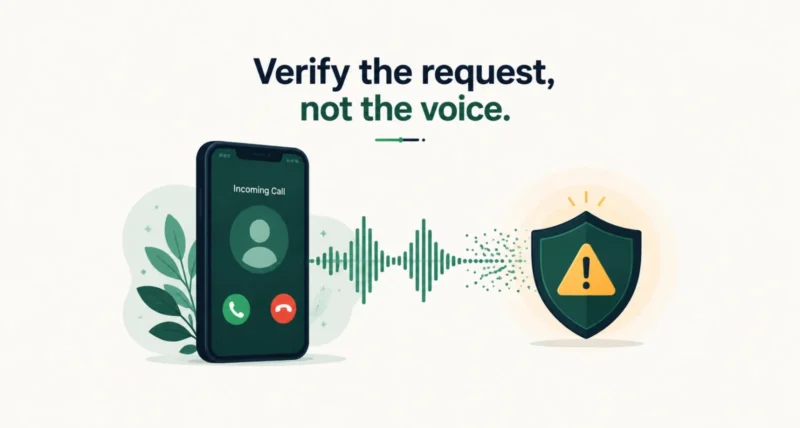
The phone rings. It is your child’s voice, panicked and crying, saying they were in an accident and need money right now. Except it is not your child. It is an AI clone built from a few seconds of audio pulled off social media. Scams like this are rising fast, which makes AI voice scam protection something every family now needs. The good news: you do not have to be a tech expert to stay safe. A few simple habits, and one family code word, can stop these scams cold. Here is exactly how they work and how to protect yourself.
| The Short Answer An AI voice scam uses cloned audio to imitate someone you trust, usually a family member in fake distress, to trick you into sending money fast. Scammers need as little as three seconds of someone’s voice, often taken from social media, to build a convincing clone. The strongest protection is simple: agree on a private family code word that only your close circle knows, and always hang up and call the person back on a number you already have. Watch for the real warning signs, which are urgency, secrecy, and unusual payment requests like gift cards or wire transfers, rather than trying to spot the fake voice by ear. If a familiar voice asks for money or secrecy, verify the request before you act. |
What Is an AI Voice Scam?
An AI voice scam, also called voice cloning, uses artificial intelligence to copy a real person’s voice and then use it to fool you. Scammers grab a short clip of someone speaking, feed it to a voice-cloning tool, and produce speech that sounds just like them.
They need shockingly little. Researchers have found that as little as three seconds of audio can produce a convincing clone, and that audio is easy to find. A TikTok video, a voicemail greeting, a YouTube clip, a podcast appearance, or a public reel can all supply the raw material. Scammers then call pretending to be a loved one in trouble, a setup often known as the family emergency or grandparent scam.
The technology has moved on, too. Newer tools clone a voice in real time during a live call, so the criminal can hold a back-and-forth conversation in someone else’s voice. As the Federal Trade Commission warns, a scammer can clone a family member’s voice from audio online, call pretending to be in trouble, and pressure you to send money right away. It is not only a family problem either, since the same trick targets businesses by imitating a boss or finance manager.
Why AI Voice Scams Are So Hard to Spot
Here is the uncomfortable truth. You probably cannot tell a cloned voice from the real one anymore. The old warning signs, like a robotic tone or strange pauses, have mostly disappeared as the technology has improved.
Experts agree it is no longer a fair fight. As CNN has reported, specialists in AI-generated media say most people can no longer reliably distinguish a clone from a genuine voice, and even they struggle to do it. So the smart move is to stop trying. Instead of asking whether the voice is real, ask whether the request makes sense. In one line: verify the request, not the voice.
How AI Voice Scams Work, Step by Step
Understanding the playbook makes it far easier to break. Almost every AI voice scam follows the same five moves.
- They find a voice sample. A few seconds of public audio from social media or a recorded call is enough to start.
- They research the target. Social media reveals who is whose grandchild, who is traveling, and other details that make the call sound specific.
- They make the call. Using the cloned voice, sometimes in real time, they pose as your loved one in a crisis.
- They create panic. An accident, an arrest, or a medical emergency, usually with a plea to keep it secret so no one can check the story.
- They demand fast payment. Gift cards, a wire transfer, cryptocurrency, or moving money to a “safe account,” always with urgency.
The Warning Signs to Watch For
Because you cannot rely on the voice, learn the behavior instead. These red flags show up in nearly every scam call.
| Red Flag | What It Sounds Like |
| Extreme urgency | “I need the money in the next hour, please hurry” |
| Secrecy | “Do not tell Mom, do not tell anyone” |
| Unusual payment | Gift cards, wire transfer, crypto, or a “safe account” |
| Heavy emotion | Crying and panic, sometimes with a second official-sounding voice |
| Dodging verification | Refuses to answer a personal question or switch to video |
Notice that none of these depend on how the voice sounds. They are about pressure and money. If a call ticks these boxes, treat it as a scam until you prove otherwise.
AI Voice Scam Protection: Your 7-Step Defense Plan
You do not need special software to beat these scams. You need a few habits, practiced before a scammer ever calls. Here is the plan.
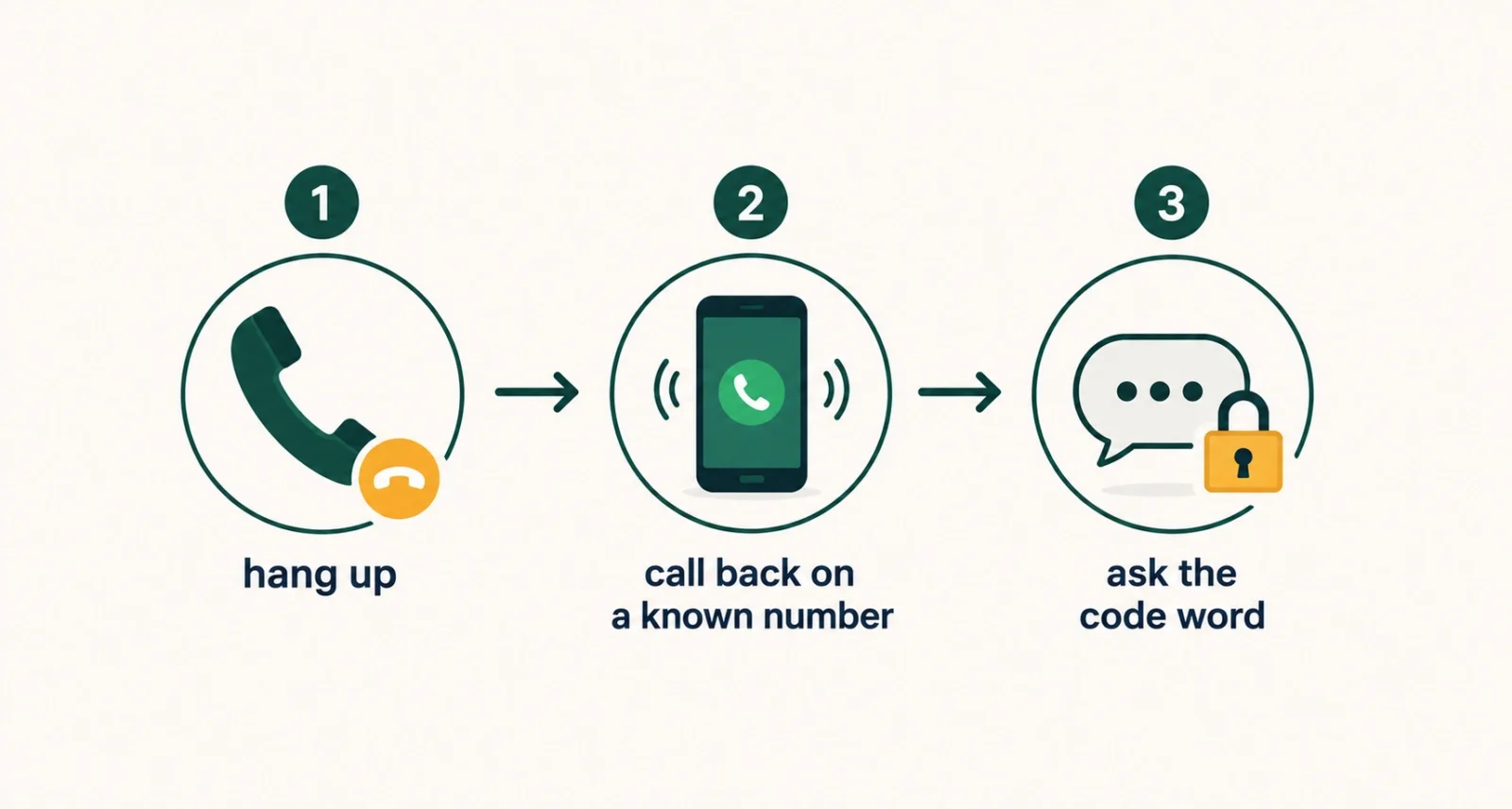
- Set a family code word. Agree on a private word or phrase that only your close circle knows, and ask for it when a call feels off. This is the single strongest defense.
- Hang up and call back. End the call, then dial the person on a number you already have saved. Never use a number the caller gives you.
- Ask a personal question. Ask something only the real person would know and that is not online, like a shared memory. A clone working from a script cannot answer.
- Slow down on purpose. Urgency is the weapon, so pausing even 30 seconds to verify breaks the whole attack. A real loved one will wait.
- Never trust caller ID or the voice alone. Scammers fake caller ID and voices easily, so treat both as unreliable and verify another way.
- Limit the audio you share. Treat your voice as personal data and be thoughtful about public videos, livestreams, and voice notes that give scammers material.
- Never pay under pressure. Any demand for gift cards, wire transfers, or crypto with urgency is a red flag. Stop and verify before moving a cent.
How to Set Up a Family Code Word
The code word deserves its own section, because it is the tactic that makes a cloned voice useless. It works precisely because a scammer cannot fake private knowledge, no matter how good the voice is.
A good code word is easy for your family to remember but impossible for an outsider to guess. Avoid anything discoverable online or easy to research, such as a pet’s name, a school, a birthday, or a street name. Pick something a little random that has meaning only inside your family.
| Do This First Set up your code word in person if you can, not over a call or text that could be intercepted. Share it only with the people who truly need it. Then agree on the rule: if someone calls claiming to be family in trouble, you ask for the code word first. If they dodge the question, get angry, or push harder for money, hang up and verify through another channel. It is far better to have your relative laugh at you for asking than to wire money to a stranger. |
How to Shrink Your Voice’s Online Footprint
You cannot erase yourself from the internet, and you do not need to. But since scammers build clones from public audio, cutting down easy material genuinely lowers your risk.
A few practical habits help without turning your life upside down.
| Habit | Why It Helps |
| Tighten social media privacy | Fewer public clips of your voice for scammers to grab |
| Ask before posting others | Check with family before sharing videos where they speak |
| Be wary of voice apps | Some “fun” AI voice apps collect voice samples you cannot get back |
| Watch what you narrate | Livestreams, reels, and long voice notes are all usable audio |
None of this removes every risk on its own. Paired with a code word and the call-back habit, though, it makes you a much harder target.
What to Do If You Have Been Targeted or Scammed
If a scam call gets through, or you have already sent money, act quickly and do not waste energy on embarrassment. These scams are built by professionals to exploit love and panic, and coming forward helps investigators and other families.
| Step | Where to Go |
| Stop the money | Call your bank or card issuer right away; speed improves your odds |
| Report the fraud | The FTC at ReportFraud.ftc.gov |
| File a cybercrime complaint | The FBI Internet Crime Complaint Center at IC3.gov |
| Get a police report | Local law enforcement, useful for bank or insurance claims |
| Get free help | AARP Fraud Watch Network Helpline, 1-877-908-3360 |
Reporting matters even if you did not lose money. The FBI’s Internet Crime Complaint Center and the FTC use these reports to spot patterns, warn the public, and pursue the people behind the scams. The AARP helpline is free and open to everyone, member or not.
AI voice scam protection comes down to a mindset shift and two small habits. The mindset: a familiar voice is no longer proof of who is calling, so verify the request rather than the voice. The habits: set a family code word, and always hang up and call back on a number you trust. Add a little care about the audio you post, and you have closed the door on the most common version of this scam.
Frequently Asked Questions
What is an AI voice scam?
An AI voice scam uses artificial intelligence to clone a real person’s voice and impersonate them, usually a family member claiming to be in trouble. The goal is to panic you into sending money or sharing sensitive information before you can verify the story. Scammers build the clone from a short audio clip, often taken from social media.
How do scammers clone a voice?
They only need a short recording of someone speaking, sometimes as little as three seconds. That audio can come from a social media video, a voicemail greeting, a podcast, or a livestream. AI voice-cloning tools then recreate the voice, and newer tools can even do it live during a call.
How can I tell if a voice is AI-generated?
Honestly, you often cannot anymore. Modern clones copy tone, accent, and emotion so well that even experts struggle to spot them by ear. That is why the reliable defense is not listening for fakes but verifying the request: ask for your family code word, hang up and call back, or ask a private question only the real person would know.
What is the best protection against AI voice scams?
A private family code word is the single strongest protection, because a scammer cannot fake knowledge they do not have. Pair it with a simple rule to always hang up and call the person back on a number you already have. Together, those two habits stop the vast majority of AI voice scams.
What should I do if I get a suspicious call?
Stay calm and slow down, since urgency is the trick. Do not send money or share details. Ask for your code word or a personal question, then hang up and call the person directly on their saved number. If you cannot reach them and fear a real emergency, contact other family or the authorities to check.
Are older adults more at risk?
Yes. The FTC, FBI, and AARP all report that people over 60 are targeted most often, partly because they may answer unknown numbers and are less familiar with voice-cloning technology. The protections are the same for everyone, so it helps to talk through the code word and call-back habit with older relatives directly.