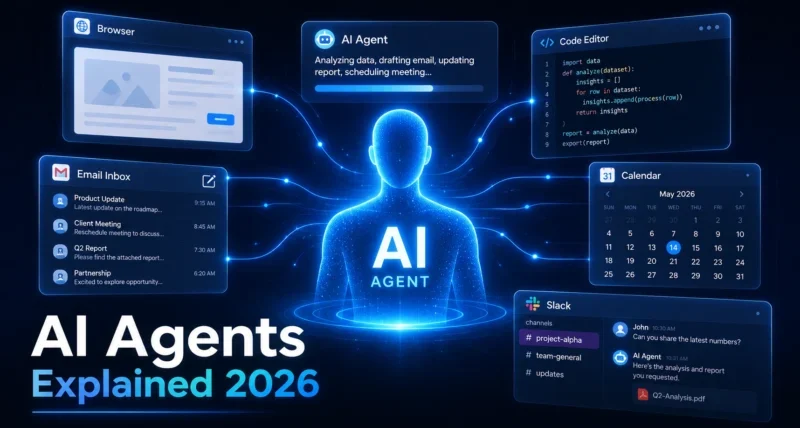
AI agents are software systems powered by large language models that take actions on their own to complete tasks. Unlike a regular chatbot, an AI agent can browse the web, click buttons, run code, send emails, and chain multiple steps together to reach a goal you set in plain language.
Key Takeaways
- AI agents are AI systems that do tasks, not just answer questions
- The category exploded in 2026 with major releases from OpenAI, Anthropic, Google, and Microsoft
- Top consumer agents right now: ChatGPT Operator, Claude Computer Use, Gemini Agent, Microsoft 365 Copilot
- Most popular real uses: coding, research, customer service, and daily admin tasks
- AI agents still need human oversight and have real limitations in 2026
What are AI agents?
AI agents are AI systems that can plan, decide, and act on their own to finish a goal. You give them a task in plain English, and they figure out the steps, use the right tools, and complete the work without you guiding every move. Think of them as the difference between an assistant who answers your questions and one who actually finishes the job.
The shift from chatbot to agent matters because it changes who does the work. A chatbot writes the email. An agent drafts it, finds the right contact, attaches the file, schedules it, and sends it.
Why AI Agents Are Trending in 2026
Three things happened in early 2026 that pushed AI agents into the mainstream.
First, the major labs all shipped agent products within weeks of each other. OpenAI launched GPT-5.5 with Operator mode in April 2026. Anthropic released Claude Opus 4.7 with deeper computer use abilities. Google rolled out Gemini Agent and Deep Research. Microsoft brought agent capabilities into Microsoft 365 Copilot.
Second, search volume for “AI agents” tripled in Q1 2026, according to multiple search trend reports. The topic moved from developer circles into everyday conversation.
Third, MIT Technology Review named agentic AI one of its 10 Breakthrough Technologies of 2026. That kind of recognition signals the start of a multi-year category, not a short trend.
If you want a deeper look at why these systems represent a fundamental change in how work gets done, our piece on Agentic AI: Digital Workers of the Future covers the bigger picture.
How Do AI Agents Work? The Three-Part System
Every AI agent runs on the same basic architecture. Once you see it, the whole category makes sense.
1. The Brain (Large Language Model)
The LLM is the reasoning engine. It reads your goal, breaks it into steps, and decides what to do next. GPT-5.5, Claude Opus 4.7, and Gemini 3.1 Pro are the most common brains powering agents in 2026.
2. The Tools (Web, Code, Apps)
Tools are what let the agent actually do things in the world. A typical agent has access to a web browser, a code interpreter, a file system, and APIs for apps like Gmail, Slack, and Google Drive. The Model Context Protocol (MCP), launched by Anthropic in late 2024, has become the standard way to give agents tool access.
3. The Memory (Context and State)
Memory is what lets agents work on long tasks without forgetting. Modern agents in 2026 hold up to 1 million tokens of context (Gemini 3.1 Pro), which means they can keep entire codebases or research libraries in mind while they work.
When you give an agent a task, it loops through these three parts: think, act, observe, repeat. That loop is what separates an agent from a chatbot.

AI Agents vs Chatbots vs AI Assistants: What’s the Difference?
This is the question almost everyone asks first. The answer is simpler than it looks.
| Feature | Chatbot | AI Assistant | AI Agent |
| Responds to questions | ✅ Yes | ✅ Yes | ✅ Yes |
| Can use tools (browser, code, apps) | ❌ No | ⚠️ Limited | ✅ Yes |
| Takes multi-step actions | ❌ No | ⚠️ Sometimes | ✅ Yes |
| Works without you guiding each step | ❌ No | ❌ No | ✅ Yes |
| Can complete real tasks end-to-end | ❌ No | ⚠️ Partial | ✅ Yes |
| Best example (2026) | Old ChatGPT | Siri, Alexa, Gemini App | ChatGPT Operator, Claude Computer Use |
A chatbot is a conversation. An assistant is a helper. An agent is a worker.
Top AI Agents You Can Use Today (2026)
Below is a comparison of the most usable consumer and prosumer AI agents available right now in May 2026. Pricing and features are current as of this publish date.
| AI Agent | Maker | Best For | Pricing | Key Strength |
| ChatGPT Operator | OpenAI | Browser tasks, bookings, research | Included in ChatGPT Pro ($200/mo) | Strongest web navigation |
| Claude Computer Use | Anthropic | Coding, computer control, long context | Claude Pro ($20/mo) or API | Best at multi-step coding tasks |
| Gemini Agent + Deep Research | Multi-source research, Google Workspace tasks | Google AI Pro ($19.99/mo) | 1M token context window | |
| Microsoft 365 Copilot | Microsoft | Office work, email, meetings | $30/user/mo for business | Best for the Microsoft ecosystem |
| Claude Code | Anthropic | Terminal coding, software development | API based | Powers Cursor, Windsurf, and top coding tool |
| Cursor / Windsurf | Various | AI-assisted coding in an IDE | $20/mo | Best developer experience |
| Replit Agent | Replit | Full app building from a prompt | Replit Core $20/mo | Builds working apps end-to-end |

How People Are Actually Using AI Agents in 2026
The hype is loud. The real use cases are quieter and a lot more useful. Here are the patterns that have stuck.
Coding and Software Development
Software engineers are the biggest power users of AI agents right now. Tools like Claude Code, Cursor, and Replit Agent can read an entire codebase, fix bugs, write tests, and ship pull requests with minimal supervision. Developers report that Claude Code fixes bugs roughly 20% faster than competing tools in head-to-head testing.
Customer Service Automation
Companies deploying AI agents for customer support are seeing 40 to 60% automation rates regardless of which underlying model they use. The agent triages tickets, pulls from the knowledge base, and escalates to a human only when needed.
Deep Research
Gemini’s Deep Research and ChatGPT’s research mode can spend 30 minutes browsing dozens of sources and producing a structured report. This is replacing what used to be an entire afternoon of analyst work.
Personal Productivity and Admin
Operator mode in ChatGPT and Claude Computer Use can book flights, fill forms, scrape data into spreadsheets, and send batch emails. If you want a broader look at AI productivity tooling, our guide to AI tools that automate your daily work in 2026 walks through specific workflows.
Marketing and Sales Operations
Agents can pull leads from LinkedIn, enrich them, write personalized outreach, schedule sends, and log activity in a CRM. This is where small businesses are getting the most leverage.
Education and Learning
Students are using agents to summarize textbooks, generate practice tests, and tutor through hard problems. Our roundup of the best free AI tools for students has options that work for school budgets.
How to Start Using AI Agents (A Realistic Guide)
You don’t need to learn coding or sign up for an enterprise plan. Here is the path most beginners are taking in 2026.
Step 1: Pick one task that bores you. Start with something you already do every week and find tedious. Common picks: research, inbox triage, scheduling, data entry, and content drafting.
Step 2: Pick the agent that fits. – For web tasks: ChatGPT Operator – For coding: Claude Code or Cursor – For research: Gemini Deep Research – For Microsoft Office work: Microsoft 365 Copilot – For Google Workspace: Gemini Agent
Step 3: Write your goal in plain English. Be specific about the outcome. Bad prompt: “Help me with email.” Good prompt: “Read my last 50 unread emails, flag anything that needs a reply today, and draft replies for the top 5.”
Step 4: Watch the first few runs. This is the most important step. Sit with the agent while it works the first three or four times. You will catch its mistakes and learn what to specify next time.
Step 5: Add it to your weekly routine. Once it works reliably for one task, do not jump to ten more. Add tasks one at a time, two weeks apart. People who try to automate everything at once usually quit.
Quick Tip: The smartest AI agent users in 2026 treat agents like a new junior team member, not a magic button. They give clear instructions, review the work, and give feedback. Quality compounds over weeks.
Limitations and Risks of AI Agents in 2026
This is the section most articles skip. Skipping it costs people money, time, and sometimes data.
Hallucinations are still real. Even GPT-5.5 and Claude Opus 4.7 produce confident wrong answers. Studies suggest hallucination rates have dropped to roughly 4% to 8% for top models in 2026, but for high-stakes work, that is still too high to fully trust.
Cost can spike fast. Agents that run for an hour and visit hundreds of pages burn through API tokens quickly. Always set spending limits before letting an agent run unsupervised.
Security is a real concern. Giving an agent access to your email, files, and bank accounts means trusting both the model and the company behind it. Studies suggest that at least one major AI agent data leak will be reported in 2026.
Reliability drops on long tasks. The longer the task, the more chances for the agent to drift off goal. Most professionals in 2026 break large tasks into smaller agent runs rather than one big run.
Regulation is unsettled. The EU AI Act and emerging US rules are starting to apply to autonomous AI behavior. Our piece on Artificial Intelligence Ethics and Regulation covers what is changing in 2026.
Myths vs Facts About AI Agents
| Myth | Fact |
| AI agents will replace all knowledge workers in 2026. | They are augmenting most roles, not replacing them. McKinsey research suggests generative AI could add $2.6 to $4.4 trillion globally, but only 5% of businesses have scaled it successfully so far. |
| AI agents work fully on their own with no human help. | The best results in 2026 come from human-in-the-loop setups where a person reviews critical steps. |
| You need to code to use AI agents. | Most consumer agents like ChatGPT Operator and Gemini Agent work in plain English. No code needed. |
| All AI agents are the same. | Each is specialized. Claude leads coding, Gemini leads research, ChatGPT leads web tasks, and Copilot leads Office work. |
The Future of AI Agents: What’s Coming Next
A few directions are clearly forming in 2026.
Agents will talk to other agents. Multi-agent systems where specialized agents hand off work to each other are already showing up in enterprise tools. Expect this to reach consumer products by late 2026.
Memory will get much better. Personal AI memory, where the agent remembers your preferences, voice, and history across sessions, is the next big differentiation point between products.
Voice will become a primary interface. The next wave of agents will let you assign and review tasks by voice while walking, driving, or working out.
Hybrid human plus AI workflows will dominate. The companies winning with AI agents in 2026 are not the ones replacing people. They are the ones designing workflows where humans handle judgment and trust calls while agents handle volume and repetition.
If you are curious how this is reshaping income opportunities, our piece on building multiple income streams with AI and remote work in 2026 breaks down practical paths.
Final Thoughts: Should You Start Using AI Agents Right Now?
If you have a repetitive task that takes more than 30 minutes a week, the answer is yes. Start small, pick one agent, and run it on one task for two weeks before adding more. The people getting the most out of AI agents in 2026 are not the ones with the biggest stacks. They are the ones with the clearest workflows.
Ready to try an AI agent today? Pick one time-consuming task from your week. Open ChatGPT, Claude, or Gemini. Describe the task in plain English. See what happens. The first run will surprise you.
Frequently Asked Questions
What are AI agents in simple terms?
AI agents are AI systems that can plan tasks, use tools, and take actions automatically.
What is the best AI agent in 2026?
The best AI agent depends on the task — Claude for coding, ChatGPT Operator for web tasks, Gemini for research, and Copilot for Office work.
Are AI agents safe to use?
AI agents are generally safe for basic tasks, but sensitive actions should always require human approval.
Do AI agents replace jobs?
AI agents mostly automate repetitive work while humans still handle creativity, strategy, and decision-making.
How much do AI agents cost?
Most AI agents range from free plans to around $20–$30/month, while advanced plans can cost $200/month or more.
Can AI agents work offline?
Most AI agents need the internet, though some open-source models can run locally on powerful devices.
What is the difference between AI agents and AI chatbots?
Chatbots only respond with text, while AI agents can also use tools, browse the web, run code, and complete tasks.